

UK & Europe → Shanghai

Clarity and coordination for your CAR-T care journey.

Independent, patient-centred support for people exploring hospital-led CAR-T assessment and treatment in Shanghai — from initial record review to travel, interpretation and follow-up planning.

No treatment guarantees. Medical decisions are made solely by qualified hospital clinicians after assessment.

LHR / EU✦SHA
Your home
UK & Europe
Coordinated care
Shanghai, China
One named coordinatorClinical liaison, logistics and language support — connected.

Built around informed choice

English-speaking coordination
Transparent next steps
Hospital-led clinical decisions
No outcome promises

A UK-registered company supporting considered access to care.

CellBridge is a UK-registered healthcare coordination company supporting international patients exploring advanced medical treatment options in Shanghai, China.

A patient coordinator discussing medical documents with an international patient and companion

We provide independent coordination support throughout the patient journey, including initial case communication, medical documentation support, hospital coordination, travel arrangements and ongoing liaison.

Our role is non-clinical.CellBridge does not provide medical diagnosis or treatment. All medical decisions are made by qualified healthcare professionals at the treating institution.

上海SHANGHAI

Access starts with a clinical opinion — not a sales promise.

Shanghai is home to major hospitals and specialist haematology and oncology teams. Availability, regulatory status, eligibility criteria and clinical pathways vary by hospital and can change.

We help patients approach this landscape carefully, seeking case-specific information from the treating institution. We do not rank hospitals, recommend a therapy as suitable, or present investigational options as established treatment.

Modern international healthcare reception environment in Shanghai

Treatment Solutions We Coordinate

Every case is different. Below are the treatment pathways we most frequently coordinate for patients travelling from the UK and Europe. All pathways are hospital-led: eligibility, clinical decisions and outcomes rest solely with the treating institution's qualified team.

A

CD19-targeted pathway

Diffuse Large B-Cell Lymphoma (DLBCL)

For relapsed or refractory DLBCL after two or more lines of systemic therapy.

What the pathway typically involves:

  • Pre-treatment PET-CT, bone marrow biopsy and cardiac function assessment
  • T-cell collection (leukapheresis, 3–5 hours)
  • Bridging chemotherapy if disease progression risk is high
  • Lymphodepletion conditioning (3 days)
  • CAR-T cell infusion (single session, 30–60 minutes)
  • Inpatient monitoring for CRS and neurotoxicity (7–14 days)
  • Response assessment at 1 and 3 months post-infusion
Evidence base:

CD19-targeted CAR-T for DLBCL has published complete response rates of 50–70% in relapsed/refractory populations. Data sourced from peer-reviewed literature including the New England Journal of Medicine and Blood.

B

BCMA-targeted pathway

Multiple Myeloma — BCMA-Targeted CAR-T

For triple-class exposed relapsed/refractory multiple myeloma.

What the pathway typically involves:

  • Comprehensive staging (serum free light chain, bone marrow, whole-body low-dose CT)
  • T-cell collection and GMP manufacturing (2–4 weeks)
  • Optional bridging therapy to control disease during manufacturing
  • Conditioning chemotherapy and BCMA-directed CAR-T infusion
  • Intensive inpatient monitoring (10–14 days)
  • Long-term follow-up for infection prophylaxis and response monitoring
Evidence base:

BCMA CAR-T programmes have demonstrated overall response rates above 85% and stringent complete response rates of 30–50% in heavily pre-treated myeloma cohorts. Published in Lancet Oncology and Journal of Clinical Oncology.

C

CD19-targeted pathway

Acute Lymphoblastic Leukaemia (ALL)

For CD19-positive relapsed/refractory B-cell ALL in adults.

What the pathway typically involves:

  • Rapid diagnostic confirmation and CNS status assessment
  • T-cell collection with same-day cryopreservation if needed
  • Bridging chemotherapy to achieve rapid cytoreduction
  • CD19-targeted CAR-T infusion
  • Extended inpatient monitoring due to higher CRS risk profile
  • Prophylactic anti-infective management and immunoglobulin replacement
Evidence base:

Adult ALL CD19 CAR-T programmes report complete remission rates of 70–90%, with subsequent consolidative allogeneic stem cell transplant recommended for durable cure in selected patients.

D

CAR-T is not a single-drug intervention. It requires parallel specialist input.

The hospital teams we coordinate with operate structured MDT frameworks covering:

Haematology / oncology(primary CAR-T physicians)
Intensive care(CRS and ICANS management)
Cardiology(baseline and event-driven cardiac monitoring)
Neurology(neurotoxicity assessment and intervention)
Infectious diseases(prophylaxis and neutropenic fever protocols)
Diagnostic imaging(PET-CT, MRI for response assessment)
Pathology(flow cytometry, MRD monitoring)

This structure exists to manage the known serious risks of CAR-T therapy, including Grade ≥2 cytokine release syndrome and immune effector cell-associated neurotoxicity syndrome.

E

Important Disclaimer

No outcome guarantees.

The response rates cited above are drawn from published clinical trials and real-world cohorts. Individual results vary.

A hospital's clinical team must assess each case independently.

CellBridge does not influence clinical decisions, rank hospitals, or present investigational therapies as established standard of care.

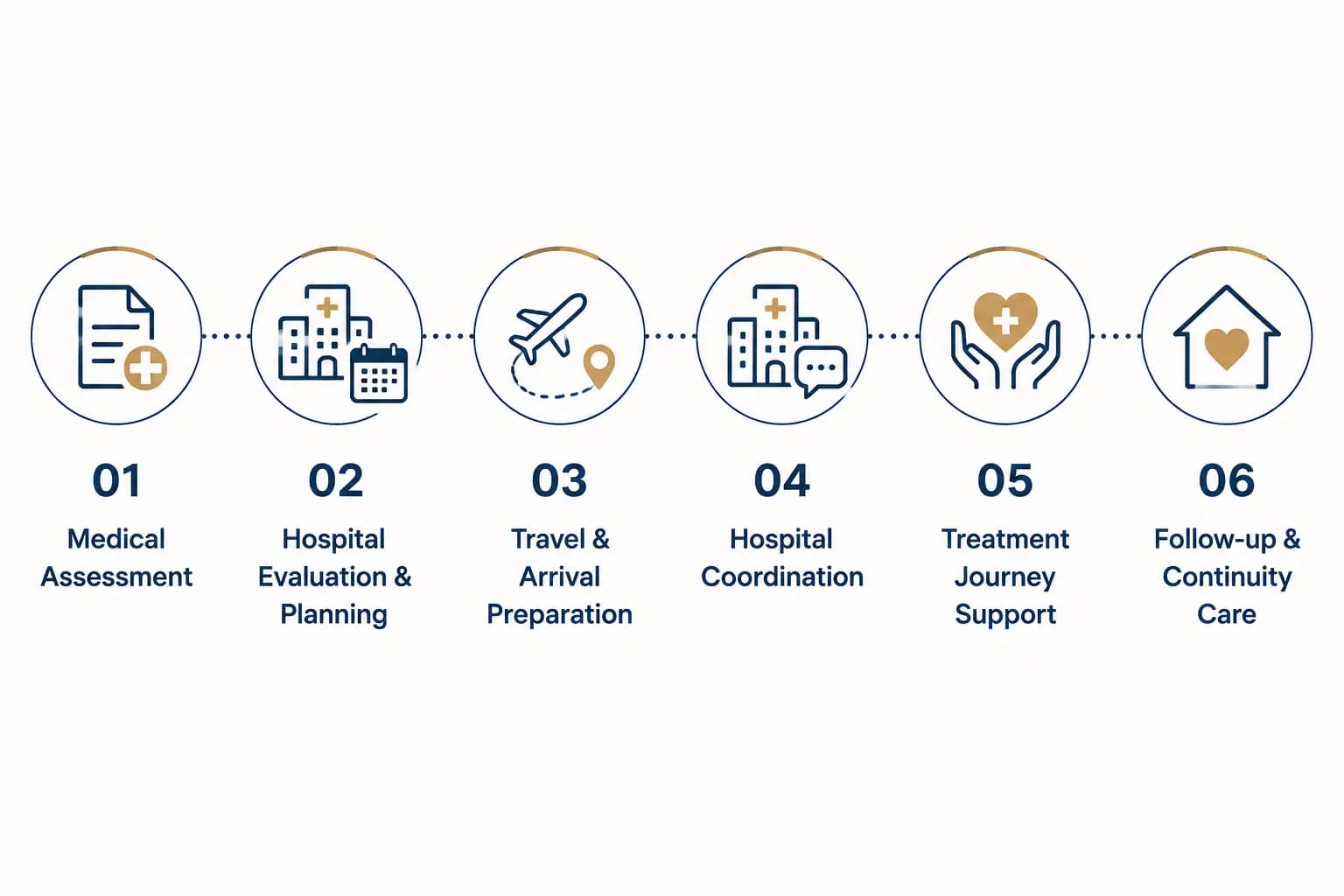
Six-Stage Patient Coordination Pathway

Six-stage patient coordination journey from medical assessment through follow-up and continuity care
01

Medical Assessment

We begin by reviewing your medical records and treatment history to understand your situation and prepare the initial coordination pathway.

02

Hospital Evaluation & Planning

We coordinate with specialist hospitals for case evaluation, treatment pathway discussions, and appointment planning.

03

Travel & Arrival Preparation

We assist with travel arrangements, visa guidance, accommodation planning, and arrival preparation.

04

Hospital Coordination

We support communication with hospitals, translation needs, administrative arrangements, and treatment logistics.

05

Treatment Journey Support

We provide ongoing coordination and practical support throughout your treatment journey.

06

Follow-up & Continuity Care

We coordinate follow-up communication and support continuity of care after you return home.

Hospital liaison, without compromised clinical independence.

Modern private hospital room used as an illustrative view of coordinated inpatient care

We coordinate with treating institutions on a case-by-case basis. Hospitals retain full responsibility for assessment, acceptance and clinical care.

01

Hospital liaison

Introductions, appointment scheduling and document exchange with selected hospital teams.

02

Medical interpretation

Professional language support for consultations and key written information where available.

03

Travel planning

Guidance on visas, accommodation, local transport and realistic companion arrangements.

04

Cost visibility

Separation of hospital charges, third-party travel costs and our coordination fees before commitment.

05

Continuity planning

Support organising records for your clinicians at home. We do not replace local follow-up care.

Clear boundaries protect patients.

We do

Coordinate information, appointments, travel and language support with your consent.

We do not

Diagnose, prescribe, provide treatment, guarantee eligibility, outcomes or timelines.

Hospitals decide

Only the responsible clinical team can assess suitability and explain benefits, risks and alternatives.

You stay informed

You should discuss overseas care with your current clinician and seek independent medical advice.

Risks are real

CAR-T can cause serious or life-threatening adverse effects and requires specialist monitoring.

Privacy matters

Health information should only be shared through agreed secure channels and with explicit consent.

Not an emergency service.If you are seriously unwell or need urgent medical attention, contact your local emergency service or treating team.

Useful answers before you begin.

Can you tell me if I am eligible for CAR-T?+

No. We can help assemble information for hospital review, but only a qualified clinical team can determine whether further assessment or treatment is appropriate.

Is treatment in Shanghai guaranteed?+

No. A hospital may decline a case, request more tests, recommend a different approach or change a plan after in-person assessment.

How much does the journey cost?+

Costs vary substantially. Before you decide, we aim to distinguish hospital estimates, coordination fees and third-party travel costs. Estimates are not final bills.

Will my UK or European doctor be involved?+

We encourage you to involve your home clinical team. With consent, we can help organise records and discharge information, but their participation cannot be guaranteed.

Do you arrange clinical trials?+

We do not promise trial access. If a hospital identifies a research study, its team must explain the study status, eligibility, consent process, alternatives and costs.

A confidential first conversation, with no obligation.

Passport, travel documents and map prepared for an international medical journey

For an initial discussion, it helps to know your diagnosis, current treating country, previous therapies and what you hope to understand.

Emailcontactus@ccbridge.co.ukPlease do not send medical records through an unverified channel.